What to consider when expanding into the Greater Bay Area?


A Greater Bay Area strategy should begin with the commercial objective, rather than with a tax rate or a specific city.

Businesses should consider:

1. What role should the GBA play in the wider Asia strategy?

This may include market access, manufacturing, sourcing, R&D, regional headquarters functions, distribution or a combination of activities.

2. Where should the business operate?

Different cities and cooperation zones have different sector strengths, incentive frameworks and strategic priorities.

3. What legal and corporate structure is appropriate?

A company operating across Hong Kong and Mainland China may need to consider the legal form, liability, tax treatment, accounting requirements and access to local incentives of each entity.

4. Which tax and investment incentives may be available?

Eligibility depends on factors including jurisdiction, location, industry, qualifying activities and investment level.

5. What cross-border tax and compliance issues need to be managed?

These may include corporate tax, VAT, individual tax residency, transfer pricing, withholding taxes and double taxation.

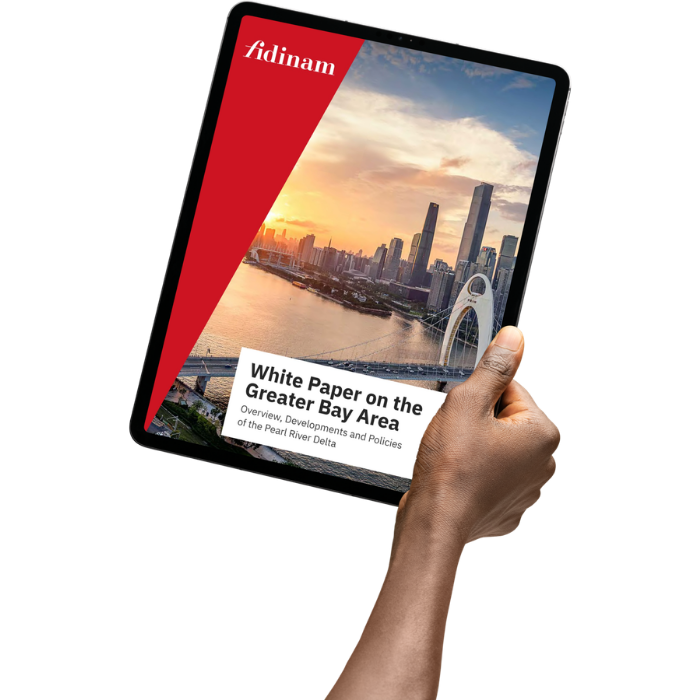
DOWNLOAD THE FULL WHITE PAPER

{horizontal_align=CENTER, css=}

What are the main Greater Bay Area cooperation zones?

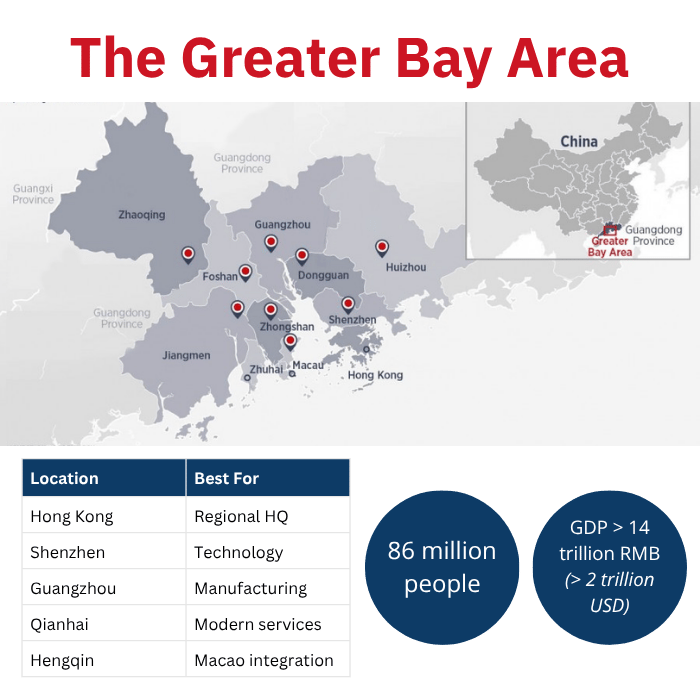
Qianhai Shenzhen–Hong Kong Modern Service Industry Cooperation Zone

Focused on modern services, cross-border finance and Hong Kong-linked professional activities.

Guangzhou Nansha Economic and Technological Development Zone

Focused on logistics, scientific innovation, international business and financial openness.

Guangdong–Macao In-Depth Cooperation Zone in Hengqin

Designed to strengthen Macao–Guangdong integration and support economic diversification.

Hetao Shenzhen–Hong Kong Science and Technology Innovation Cooperation Zone

Focused on Shenzhen–Hong Kong collaboration in science, technology, research and innovation.

What tax incentives are available in the Greater Bay Area?

  • Mainland China
  • Hong Kong

There is no single “GBA tax regime”. Tax treatment depends on the jurisdiction in which the company or individual operates.

Mainland China

15% corporate income tax for qualifying enterprises (instead of 25%)
5% rate for qualifying small low-profit enterprises
200% R&D super deduction
Tax credit for reinvested foreign dividends
Certain income associated with activities including agricultural projects, nationally significant infrastructure, environmental protection, and technology transfers may qualify for exemptions under Mainland China tax rules.
Qualifying high-end and urgently needed professionals working in the Greater Bay Area may benefit from subsidy programmes that reduce their effective individual tax burden from up to 45% to 15%, subject to local eligibility rules.

Fidinam can assess which tax incentives may be relevant to your business and help structure operations across the GBA. 

Hong Kong

Hong Kong operates a territorial tax system, meaning taxation generally focuses on profits sourced in Hong Kong.

Other key characteristics include:

no VAT or GST;
no general tax on dividends;
no general capital gains tax; and
a comparatively simple corporate tax framework.


Beyond tax rates, Hong Kong provides a range of government support schemes for SMEs, innovation-led companies and businesses expanding internationally. These include R&D tax deductions, I&T funding, export and market development support, and sector-specific funding schemes. 

Fidinam can assess which tax incentives may be relevant to your business and help structure operations across the GBA. 

Hetao Shenzhen–Hong Kong Science and Technology Innovation Cooperation Zone

Hetao Shenzhen–Hong Kong Science and Technology Innovation Cooperation Zone

Key industries and investment opportunities in Guangdong

Guangdong is one of China’s most important manufacturing and innovation centres.

The White Paper identifies 20 strategic industrial clusters, including 9 exceeding RMB 1 trillion in value (over 148 billion USD).

New-generation electronic information

New-generation electronic information

green petrochemicals

Green petrochemicals

Smart home appliances

Smart home appliances

Automobiles

Automobiles

Advanced materials

Advanced materials

Modern light industry & textiles

Modern light industry and textiles

Software & information services

Software and information services

Modern agriculture & food

Modern agriculture and food

New energy

New energy

DOWNLOAD THE FULL WHITE PAPER

{horizontal_align=CENTER, css=}

Why companies choose Fidinam 

With more than 600 clients served across Asia and 15 years of experience in the Greater Bay Area, Fidinam combines local expertise with an international perspective. Our teams in Hong Kong and Guangzhou, supported by our international network, help European and Asian businesses manage the practical and strategic aspects of operating across borders.

Our experience spans a range of industries, including manufacturing, technology, financial services, professional services, retail and consumer goods, allowing us to tailor our approach to the specific needs of each business.

  • Presence in Hong Kong and Guangzhou
  • International tax specialists
  • Cross-border structuring experience
  • Incorporation, tax, accounting and payroll under one provider
  • European and Asian market-entry expertise

 Frequently Asked Questions about the Greater Bay Area 

What is the Greater Bay Area?

The Guangdong–Hong Kong–Macao Greater Bay Area is an economic region comprising Hong Kong, Macao and nine cities in Guangdong Province. It aims to strengthen economic integration, infrastructure connectivity, innovation and cross-border cooperation.

Which cities are in the Greater Bay Area?

The GBA includes Hong Kong, Macao, Guangzhou, Shenzhen, Zhuhai, Foshan, Huizhou, Dongguan, Zhongshan, Jiangmen and Zhaoqing.

Is there one tax system across the Greater Bay Area?

No. Hong Kong, Macao and Mainland China operate different tax systems. Companies therefore need to assess tax treatment based on the jurisdiction and location of their activities.

What is the corporate tax rate in Mainland China?

The standard Enterprise Income Tax rate is 25%, although qualifying high-tech enterprises, encouraged sectors and certain businesses in designated areas may qualify for reduced rates.

What is the corporate tax rate in Hong Kong?

Hong Kong’s standard Profits Tax rate is 16.5%, with a two-tier system applying a reduced 8.25% rate to the first HKD 2 million of assessable profits for qualifying businesses.

What are the main GBA tax incentives?

Examples include preferential corporate income tax rates for qualifying enterprises, R&D deductions, investment-related tax credits and individual tax subsidy programmes for qualifying talent. Eligibility depends on the jurisdiction, location, sector and activity.

Fidinam can assess which tax incentives may be relevant to your business and help structure operations across the GBA. 

What are Qianhai, Nansha, Hengqin and Hetao?

They are major cooperation and development zones within the Greater Bay Area, each with a different strategic focus. Qianhai emphasises modern services and finance, Nansha logistics and international business, Hengqin Macao integration, and Hetao science and technology cooperation.

Fidinam can support location assessment, entity setup and cross-border structuring when evaluating Qianhai, Nansha, Hengqin or Hetao. 

How can Fidinam support companies entering the Greater Bay Area?

Fidinam supports businesses with corporate structuring, market entry, tax advisory, accounting, compliance and other cross-border business requirements across Hong Kong and Mainland China.

CONTACT

Speak with our Greater Bay Area team